
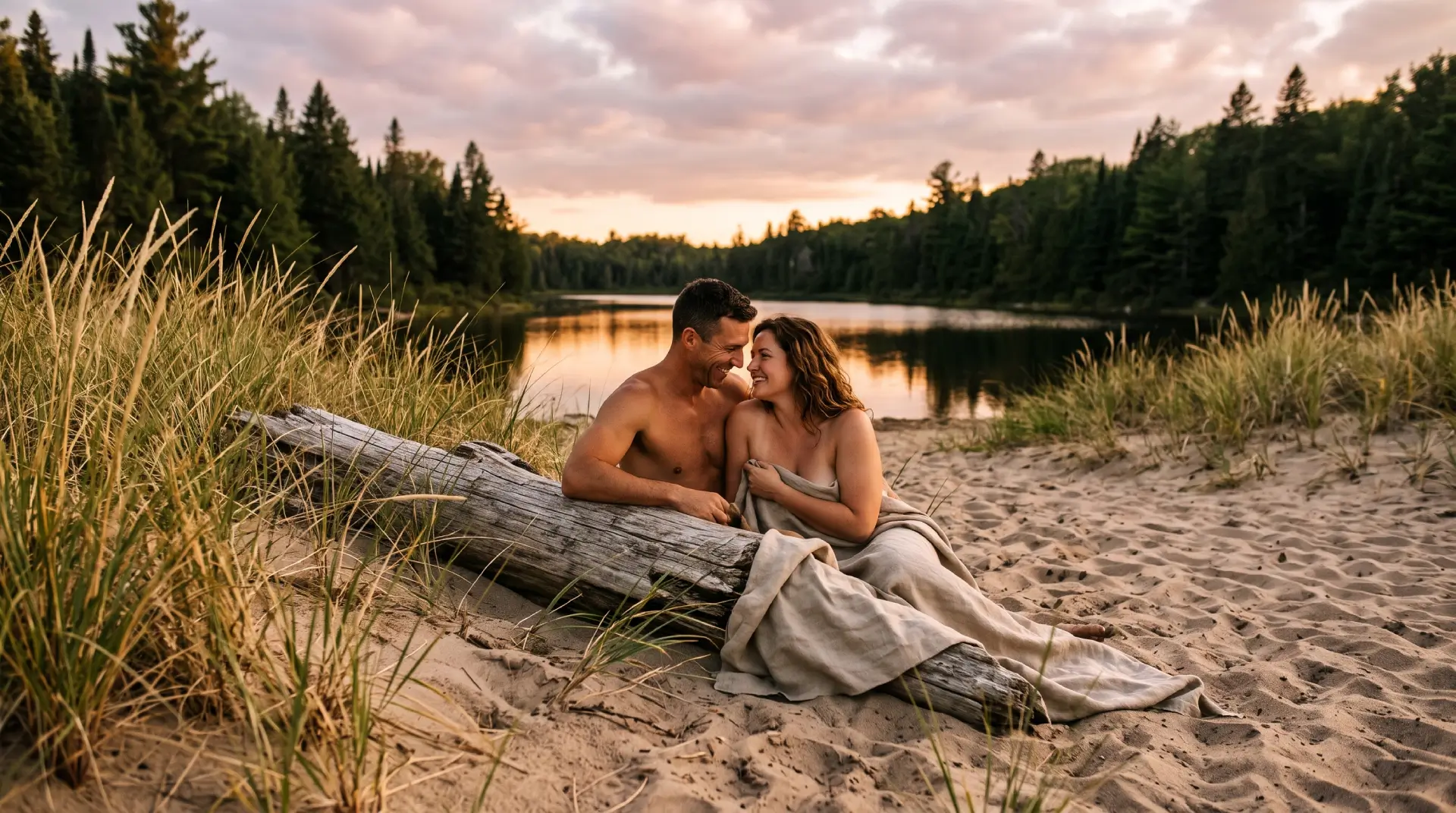
Sex on the beach sounds like the ultimate sun-soaked fantasy… or a tasty alcoholic drink. Warm air, rolling waves, bare skin, even the thrill of getting caught, all can make for a very wild adventure. In reality, however, public sex on the beach can expose couples to arrest, injuries, infections and unwanted encounters with other beachgoers.
While the fantasy may be thrilling, bringing it to life on a public beach or shoreline can cross legal boundaries and compromise the privacy and comfort of others.
Fortunately, you can still enjoy that naughty beachside excitement by opting for private accommodations, adults-only venues, or secluded properties where intimate activities are permitted and everyone’s privacy is respected.
The Definition of Public Sex on the Beach
Public sex on the beach generally means engaging in sexual activity in an area adjacent to water and sand that could possibly be accessible or visible to members of the public. This could include a municipal beach, public park, boardwalk, shoreline, parking area, public restroom or even a busy recreation area filled with vacationers.
Just because a location feels deserted after dark doesn’t mean it’s private or suitable for outdoor intimacy. Even seemingly empty beaches during the day can attract unexpected visitors, from families and beachgoers to security staff, maintenance crews, and law enforcement.
True privacy takes more than a little luck and hoping nobody happens to wander by. Before letting spontaneity take over, think ahead about your surroundings, choose an appropriate setting, and make sure your plans won’t intrude on anyone else’s space or comfort. A little preparation can go a long way toward keeping the experience fun, carefree, and memorable for all the right reasons!
I would take this in a slightly different direction. Rather than suggesting that beaches have historically been places for sexual freedom, I’d explore how beaches became sites of changing attitudes toward the body, sexuality, nudity, and personal freedom. There are some genuinely interesting historical details that make this section much stronger.
Historical Context: From Victorian Modesty to Beachside Sexual Freedom
The beach hasn’t always been the relaxed, body-positive playground we know today. During the nineteenth century, seaside bathing was governed by strict social conventions. In Britain, Europe, North America, and elsewhere, swimming was often segregated by gender, nudity was subject to local restrictions, and even the sight of a person in a bathing costume could provoke moral outrage. Bathing machines, changing enclosures, and modesty regulations were introduced to control how much of the body could be seen in public.
By the early twentieth century, attitudes were beginning to shift. Swimming became increasingly popular as a recreational activity, mixed-gender bathing gained acceptance, and swimwear gradually became less restrictive. In some American beach communities, authorities even introduced regulations specifying how much skin men’s and women’s bathing suits could reveal. The changing beach wardrobe became a surprisingly public battleground over morality, gender expectations, and personal freedom.
The twentieth century also saw the growth of organized naturist movements, which challenged conventional ideas about public nudity. Beginning in Germany in the late nineteenth century and spreading internationally, naturism promoted social nudity as a lifestyle associated with health, nature, and body acceptance rather than necessarily sexual activity. By the 1950s, organized naturist communities were campaigning for greater acceptance and access to designated beaches and recreational spaces.
Meanwhile, the sexual revolution of the 1960s and 1970s brought broader changes in attitudes toward sexual expression, relationships, and personal autonomy. Beaches increasingly became associated in popular culture with sensuality, flirtation, topless sunbathing, and sexual liberation. For LGBTQ+ communities, certain beaches also became important social gathering places, offering opportunities for connection and visibility at a time when discrimination and restrictions on public expression remained widespread.
Today, the beach continues to occupy an interesting place in our collective imagination: somewhere between recreation, romance, sensuality, and freedom. Although the history of beach culture has helped shape modern attitudes toward bodies and sexuality, it is important to distinguish between social nudity, sexual expression, and public sexual activity. Each has its own cultural and legal history, and enjoying the freedom of a beach doesn’t mean abandoning the importance of consent, privacy, or respect for others.
Legal Challenges of Having Public Beach Sex
Although laws differ by jurisdiction, visible sexual activity may be treated as public indecency, indecent exposure, disorderly conduct, lewd conduct or another criminal offense. Depending on the location and circumstances, possible penalties for sex on the beach can include citations, fines, probation or imprisonment.
A conviction may have consequences beyond the initial criminal case. Certain offenses can affect employment, travel or housing, while some serious convictions may trigger registration requirements under applicable sex offender laws. That does not mean every public-sex offense automatically leads to registration, but the possibility is far too serious to dismiss for a quick hump.
Rules also vary among states and municipalities. South Carolina law is not identical to Texas or Florida law, and an ordinance in Long Beach may differ from one in Austin or Miami-Dade. A misdemeanor of the first degree in one jurisdiction may be categorized differently elsewhere. Overseas destinations, including Cyprus, have their own standards as well.
Before planning anything intimate, consult official government information or a qualified local attorney. Do not rely upon videos, internet rumors, anonymous users or a travel website’s Terms and Conditions as substitutes for legal advice.
Get the facts, before you get naked.
Economic Impact on Local Communities
Beaches support hotels, restaurants, entertainment venues and other local businesses. A lively, welcoming atmosphere can attract visitors and generate sales tax revenue. However, complaints about public sexual behavior may require additional patrols, cleanup and intervention from law enforcement agencies.
Communities therefore try to balance tourism with the comfort of residents and visitors. An adults-only resort may deliberately cultivate a flirtatious atmosphere, while a family beach has very different expectations.
Public Safety
Public safety and consent should always be part of the equation when considering outdoor intimacy. Remember that unsuspecting beachgoers have not agreed to witness sexual activity, and families with children may unexpectedly enter an area you thought was secluded. Public beaches are shared spaces, and everyone deserves to enjoy them without being exposed to unwanted sexual behavior.
Privacy is another important consideration. Smartphones and cameras make it easy for someone to record an intimate encounter and potentially share the footage without your knowledge or permission. Beyond the embarrassment, this can become a serious violation of personal privacy.
Be aware of your surroundings, respect the people sharing the space, and understand when affectionate behavior crosses the line into public sexual activity. The goal is to enjoy your adventure without compromising anyone else’s comfort, safety, or consent.
Political and Cultural Factors
Ideas about nudity and acceptable conduct vary enormously. Some communities treat nonsexual social nudity as ordinary, while others restrict even topless sunbathing. A clothing-optional beach is not automatically a sexual venue. Nudists generally expect visitors to respect consent, personal space and rules against overt sexual behavior.
Evolution of Societal Attitudes
Popular culture has played a significant role in romanticizing beachside intimacy. From steamy movie scenes and suggestive song lyrics to celebrity anecdotes and vacation fantasies, sex on the beach is often portrayed as spontaneous, adventurous, and irresistibly tempting. These portrayals have helped make the idea part of our collective sexual imagination, even if the reality is sometimes considerably less glamorous!
However, changing attitudes toward consent have added an important dimension to the conversation. Sexual freedom means having the opportunity to explore desire with a consenting partner, but it also means respecting the rights of others who haven’t agreed to witness or participate in someone else’s sexual adventure.
Shifts in Cultural Norms
Today’s travelers have more opportunities to explore their sexuality in appropriate settings than previous generations. Adults-only resorts, private villas, clothing-optional retreats, lifestyle resorts, and organized adult events can offer greater freedom while maintaining privacy and respecting boundaries.
It’s important, however, to understand that not all adult-friendly destinations have the same rules. Clothing-optional, topless, adults-only, and sexually permissive are very different classifications. A resort may welcome nudity without allowing sexual activity in shared spaces, while another may offer designated areas or events specifically for intimate encounters.
As attitudes toward sexuality continue to evolve, so do the opportunities for adults to enjoy more adventurous vacations. The trick is knowing which destinations genuinely welcome sexual expression, which restrict it, and where private beachside intimacy is permitted. A little research before booking can make the difference between a memorable romantic getaway and an uncomfortable encounter with local authorities!
Re-evaluating the Use of Public Spaces
A public beach is a shared community space, not an extension of someone’s private bedroom. Just because a shoreline offers a romantic setting or a secluded-looking spot doesn’t mean it’s appropriate for sexual activity. The same considerations apply to public restrooms, changing areas, and other facilities intended for communal use.
For couples looking to add a little outdoor adventure to their sex lives, there are better alternatives. Private properties where intimate activity is permitted, screened patios, secluded villas, and privately booked beachfront accommodations can provide the freedom and privacy you’re looking for. Always check with property owners or management about their rules rather than assuming that seclusion means permission.
Everyone deserves the freedom to explore their sexuality without unnecessary judgment or discrimination. At the same time, communities have a responsibility to maintain safe and comfortable shared spaces. Finding that balance means choosing environments where intimacy is welcomed, privacy is respected, and everyone involved has consented to what they might encounter.
Importantly, public-decency rules should be applied fairly and consistently, without discrimination based on sexual orientation, gender identity, or relationship style. Sexual freedom and responsible respect for shared spaces aren’t opposing ideas; they can and should coexist.
Current Regulations and Their Impact
Enforcement varies according to local law, visibility, complaints and surrounding circumstances. Officers may respond after being contacted by witnesses or through routine patrols. A local police department, criminal division or Department of Law Enforcement may become involved depending on jurisdiction.
In the United States, state registries and frameworks such as the Florida Sexual Offender/Predator Registry operate under detailed eligibility rules. Broader legislation, including the Florida Sexual Predators Act and federal measures historically associated with the Jacob Wetterling Act, demonstrates why assumptions about consequences are dangerous. Only a local legal professional can explain how a particular charge might be treated.
The Challenges of Having Public Sex on the Beach
The biggest challenge is not sand — it is the lack of genuine privacy. Darkness, dunes and distance can create a false sense of seclusion. Beaches may have cameras, patrols, nearby homes or visitors arriving at unpredictable hours.
Weather and tides can change quickly. Alcohol may also impair judgment, making couples less aware of hazards, boundaries and other people. If a setting requires constant fear of discovery, it is probably not an appropriate place for intimacy.
Finding Privacy Without Breaking the Rules
The appeal of outdoor intimacy often comes from the feeling of adventure and spontaneity, but trying to avoid detection or sneak around in public spaces can quickly turn an exciting experience into a legal headache. Rather than taking chances with public-decency laws, choose a location where privacy and permission are already part of the arrangement.
Consider booking a private beachfront room, secluded villa, or accommodation with an enclosed patio or outdoor space. Before making plans, check with the property owner or management to confirm whether outdoor intimate activities are permitted and whether the space is genuinely private from staff, neighboring guests, and passersby.
The idea is to enjoy the freedom of an outdoor setting without worrying about unwanted interruptions, complaints, or legal consequences. After all, the best kind of adventure is one where you can relax, enjoy each other, and know you’re respecting everyone’s boundaries.
I’m Getting Sand Everywhere!
Sand is wonderful beneath a towel but irritating on intimate skin. Grains can cause tiny abrasions, especially when combined with friction, salt and perspiration. Seawater is not a lubricant, and it can wash away natural or commercial lubrication. Water also does not prevent pregnancy or sexually transmitted infections.
Protect your pink parts best you can if you are thinking of exposing them to the elements, if even for a brief time and just pulling your suit aside for quick access. Water and pale sand also reflect ultraviolet radiation, increasing exposure to the sun’s rays.
Additional hazards include broken shells, sharp rocks, insects, strong currents, heat exhaustion and sunburn.
Keep intimate activity on a large blanket, cabana bed or other clean surface within an authorized private area. Avoid placing irritated skin directly against sand, and shower afterward with fresh water. Stop if either partner experiences pain, burning or abrasions. Persistent discomfort, unusual discharge or signs of infection deserve medical attention.
Public Sex on the Beach FAQs
Are there any spots that promote couples having sex on their beach?
Some adults-only lifestyle resorts provide private areas where consensual intimacy is permitted. Confirm the current rules directly with the property. A nude beach alone is not permission.
What Are the Best Sex Positions to Enjoy in the Sand?
Let’s be honest: sand isn’t exactly the most comfortable or stable surface for experimenting with adventurous sex positions. While the idea of getting frisky on the beach sounds wonderfully spontaneous, attempting complicated Kama Sutra moves on shifting sand can quickly become more challenging than sexy!
If you’re planning a private beachside getaway where intimacy is permitted, stick to comfortable, supported positions that don’t require too much balancing or acrobatics. A few options worth considering include:
- Missionary: A familiar favourite that allows partners to stay close and enjoy face-to-face intimacy. A clean, padded surface makes it considerably more comfortable.
- Spooning: A relaxed side-by-side position that requires minimal balancing and allows for plenty of skin-to-skin contact.
- Seated Face-to-Face: One partner sits on a sturdy, stable surface while the other sits facing them on their lap, making it easy to maintain closeness and eye contact.
- Side-by-Side: A laid-back option that takes pressure off the knees and wrists while keeping both partners comfortably supported.
- Cowgirl: With one partner lying on a stable, padded surface, the other takes the lead on top. This position offers flexibility and control without requiring elaborate manoeuvres.
Of course, the beach itself presents a few challenges. Shifting sand can make it difficult to maintain balance, while rough grains can irritate sensitive skin and get into places you’d really rather they didn’t! Uneven ground also increases the risk of slips, falls, and strained joints.
Our advice? Save the more adventurous acrobatics for the bedroom and bring a comfortable, clean, waterproof blanket or padded surface to your private outdoor setting. You want your beachside adventure to leave you with wonderful vacation memories, not a twisted ankle and an embarrassing explanation at the local medical clinic!
Is it safe to have sex in the ocean?
Oceans carry real risks involving currents, reduced lubrication, irritation, contamination and loss of barrier protection. And crabs and jellyfish!
Having sex in shallow water does not eliminate those risks.
Where are the best beaches to have sex?
The best option is a privately owned or exclusively reserved beachfront location where management explicitly permits adult intimacy and no nonconsenting person can observe it.
What body parts get sunburned quickest?
Previously covered areas, including the chest, buttocks and genitals, can burn rapidly. Use shade and suitable clothing; sunscreen should not be applied internally or allowed to degrade latex barriers.
How Do I Organize a Beach Orgy?
If you’re interested in organizing a group sexual gathering with a beachside theme, the first step is finding an appropriate private venue. Look for adults-only resorts, private beachfront properties, or lifestyle venues that specifically permit organized adult events. Public beaches are not suitable locations for sexual gatherings.
A successful event also requires thoughtful planning. Make sure all attendees are verified adults, establish clear consent and participation guidelines, provide appropriate sexual-health supplies, and have event organizers available to address safety concerns. Privacy is equally important, so establish firm rules against unauthorized photography or recording.
The goal is to create a welcoming, sex-positive environment where consenting adults can explore their interests comfortably, safely, and without involving unsuspecting members of the public.
Is there social media for having sex on the beach?
Yes! There are social networks and adult lifestyle communities where people connect with like-minded couples and singles interested in beachside adventures, naturism, swinging, and outdoor intimacy. While you won’t necessarily find a platform dedicated exclusively to having sex on the beach, several adult-oriented communities offer opportunities to meet people with similar interests.
Some places to explore include:
- TangledBodies.com – A dating and social discovery app popular with open-minded singles and couples exploring alternative relationships within the lifestyle and sexual interests.
- FetLife – An adult social network where members connect through shared interests, groups, discussions, and local events.
- SLS – A lifestyle community for swingers and couples interested in meeting others and discovering adult events.
- Reddit – Various adult-oriented communities discuss beach experiences, naturism, swinging, and outdoor fantasies. Some groups to explore include:
https://www.reddit.com/r/SandyBottomsResort/, https://www.reddit.com/r/TeddyBarePicnic/, and, https://www.reddit.com/r/SwingersEventsDating/.
You may also find specialized naturist and swingers groups that organize private beach gatherings or adults-only vacations.
A little caution: Always check that events take place in permitted private settings, protect your personal information, and establish clear consent and privacy boundaries before meeting anyone.
CONCLUSION
Public sex on the beach may be an irresistible fantasy, but the sexiest version is one built around consent, privacy and preparation. Find a legal private setting, protect yourselves from sun and sand, respect the surrounding community — and let the waves provide the soundtrack without making strangers part of the show.